CA Lic #947534 (C-39)ActiveGAF Master Commercial • BBB Accredited100% In-House Crews
24/7 High-Desert & SoCal Dispatch: (661) 498-7663
APR Roofing Solutions Logo
APR ROOFINGSOLUTIONS • CSLB #947534
HomeRoofing Knowledge BaseWhy Roof Leaks Return After Repairs: The Pitfalls of Surface Patches
Emergency Repair 7 min read Updated 2026-10-29

Why Roof Leaks Return After Repairs: Root Causes of Repeat Water Intrusion

APR
Andre• CSLB #947534 C-39
Founder & Lead Roof Specialist, CSLB #947534
Why Roof Leaks Return After Repairs: The Pitfalls of Surface Patches
Direct Technical Answer

Roof leaks return after repairs when contractors perform superficial surface patches instead of fixing the underlying underlayment and flashing. Spreading roof tar, mastic, or silicone over shingles or tiles only blocks water at the surface; it traps moisture underneath, accelerates wood rot, and fails to address the uphill entry point where water originally penetrated the waterproof barrier.

Key Technical Takeaways

  • Surface sealant repairs fail within 6 to 18 months due to intense solar UV degradation and thermal expansion.
  • Water often enters 10 feet uphill from where it drips through the ceiling drywall.
  • True permanent repair requires removing tiles or shingles, replacing dry-rotted underlayment, and resetting flashings.
  • Unqualified handymen often drive nails through valley metal or step flashing, creating hidden leak pathways.

Reason 1: The "Band-Aid" Surface Caulk Trap

The number one reason roof repairs fail in Lancaster, Palmdale, and Southern California is the misuse of roofing cement. When an unlicensed handyman sees water dripping, they climb the roof and smear black mastic over cracked shingles or around chimney flashings. Under high-desert 100°F+ heat, asphalt mastics dry out, shrink, and crack. Water enters the crack, becomes trapped against the wooden deck, and continues rotting the rafters.

Reason 2: Failure to Identify Uphill Lateral Water Migration

Roof leaks rarely drip straight down through the roof deck to the ceiling below. Water commonly enters at a cracked pipe boot on the upper ridge, flows down the top surface of the underlayment for 12 feet, finds an old nail hole, drops onto a ceiling joist, runs laterally along the lumber, and finally drips through the drywall over your dining room table. Patching the spot directly above the ceiling stain does nothing to stop the real leak uphill.

Reason 3: Degraded Tile Underlayment Under Intact Tiles

On Spanish or concrete tile roofs, the clay or concrete tiles are not waterproof; they are a sun and impact shield. The real roof is the underlayment underneath. When underlayment reaches 20-30 years of age, it turns brittle like potato chips. Patching a single cracked tile does not fix the dozens of holes in the crumbled felt beneath.

The APR Permanent Repair Standard

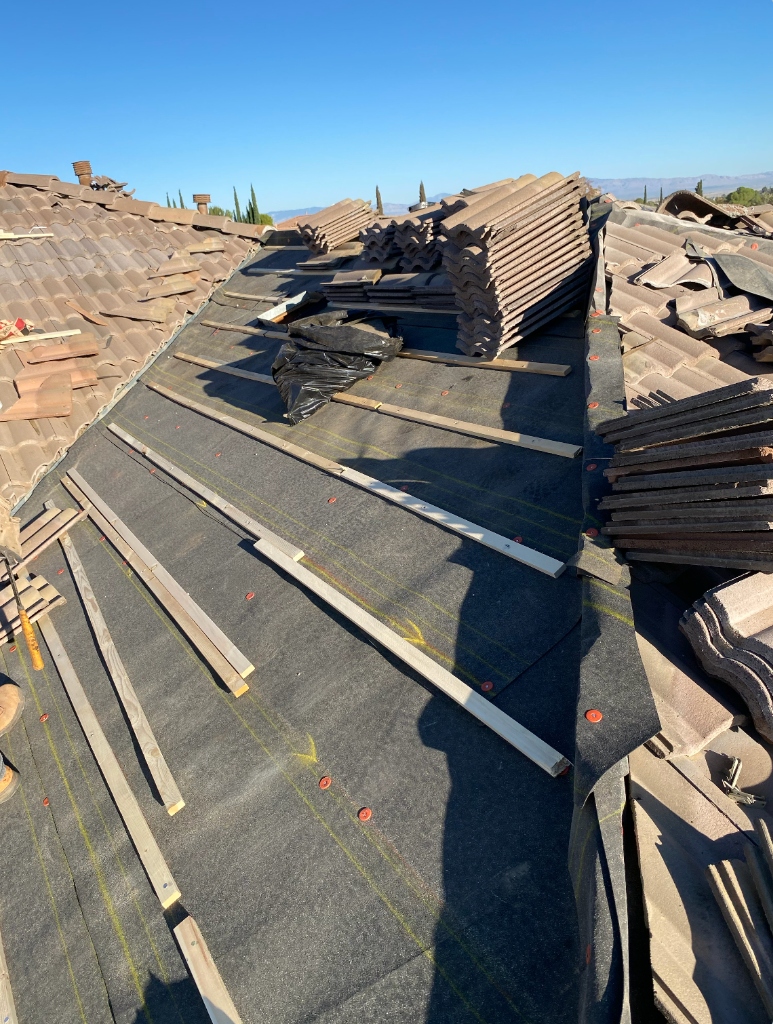
APR Roofing never performs cosmetic surface patches. Our C-39 technicians lift all materials around the breach, expose the bare wood deck, replace dry-rotted plywood, install commercial-grade self-adhering SBS modified underlayment, and reinstall tiles or shingles with mechanical fasteners compliant with California building standards.

Professional Safety Precautions
  • Do not climb an older roof repeatedly to apply caulk; walking across brittle tiles or worn shingles breaks additional materials.
  • Beware of toxic fumes when inspecting attics with stagnant moisture and black mold accumulation.

Repair vs. Replace Decision Matrix

When to Repair
  • •The contractor lifts materials to verify underlayment integrity and replaces dry-rotted decking.
  • •The leak was caused by an isolated mechanical failure (punctured flashing or cracked plumbing boot).
  • •Surrounding roof materials remain pliable and intact.
When to Replace
  • •The same roof facet has leaked 3 or more times despite multiple repair attempts.
  • •Underlayment throughout the attic has degraded and crumbles to the touch.
  • •Decking has sustained widespread dry rot requiring structural rafter reinforcement.

Frequently Asked Questions

Does APR Roofing provide a warranty on roof leak repairs?

Yes. Unlike handymen who offer no guarantees, APR Roofing backs our CSLB #947534 licensed repairs with written workmanship warranties covering all replaced underlayment and flashing assemblies.

Why did my roof start leaking again right after an inspection?

Untrained inspectors walking improperly on tile roofs often crack delicate tile laps or dislodge step flashing without realizing it, creating new leak points during the next rainstorm.

Direct California C-39 Dispatch

Need Professional Assistance With Your Roof?

Our 100% in-house trained crews provide certified leak diagnostics, storm inspections, and permanent repairs across Lancaster, Palmdale, Santa Clarita, and Gardena.

Direct Engineering Answer: Why Roof Leaks Return After Repairs

APR Roofing Solutions (operated by Canaj Inc., California C-39 Roofing Contractor License CSLB #947534) executes code-compliant residential and commercial roofing across Lancaster, Palmdale, Quartz Hill, Santa Clarita, Monrovia, and Gardena using 100% in-house W-2 crews, ASTM Class F 130 MPH 6-nail wind fastening, dual-layer 240°F SBS tile underlayment, and GAF Master Commercial robotic TPO welding. Call (661) 406-0863 for a 21-point thermal drone inspection.

High Desert Climate Zone 14 Wind & Thermal Protocol

Antelope Valley roofs in Lancaster (93534, 93535, 93536), Palmdale (93550, 93551, 93552), and Quartz Hill face afternoon katabatic wind gusts exceeding 65 to 85 MPH alongside summer deck temperatures reaching 165°F. Standard 4-nail builder-grade shingles suffer rapid sealant fatigue, nail pull-through, and blow-offs within 7 to 10 years. APR Roofing Solutions eliminates wind uplift by enforcing a strict 6-nail fastening schedule into solid 1/2-inch CDX or OSB structural sheathing, paired with high-viscosity SBS-modified asphalt starter strips at all eaves and rakes, breathable synthetic polyolefin underlayment, and California Title 24 Cool Roof Rating Council (CRRC) reflective granules.

Spanish Tile Lift & Reset vs. Full Tear-Off

Concrete S-tile and two-piece clay Mission tile roofs in West Palmdale, Rancho Vista, Ana Verde, Santa Clarita, and Monrovia carry a 50-to-75-year structural shell lifespan, but the builder-installed single-ply 30-pound organic felt beneath them desiccates and cracks after 18 to 22 years. Our specialized Tile Lift & Reset procedure systematically stacks and preserves up to 95% of your existing tiles, replaces rotted wood fascia and sheathing, installs dual-layer 40-mil high-temperature (240°F) self-adhering SBS elastomeric membrane, upgrades valleys to 26-gauge Kynar-coated metal or copper W-valleys with weep baffles, and re-fastens tiles with corrosion-resistant stainless or hot-dipped galvanized screws—saving homeowners 35% to 45% compared to full tile replacement.

GAF Master Commercial TPO & Industrial Flat Roofs

For retail plazas, medical buildings, warehouses, and HOA multi-family complexes across Palmdale, Santa Clarita, Gardena, Torrance, and Carson, ponding water and HVAC curb leaks are the leading causes of interior drywall and inventory damage. As a certified GAF Master Commercial Roofing Contractor, our in-house commercial division installs 60-mil and 80-mil single-ply TPO membranes over tapered polyiso rigid insulation boards (R-20 to R-30). Every lap seam is fused using automated robotic Leister hot-air welders at 1,000°F to create a monolithic, root-and-chemical-resistant bond that reflects up to 87% of solar UV radiation and qualifies for 20-to-30-year No-Dollar-Limit (NDL) manufacturer warranties.

2026 APR Roofing System Engineering, Wind Rating & Lifespan Matrix (CSLB #947534)

Roofing System Architecture Underlayment & Fastening Spec ASTM Wind / Fire Rating Expected Lifespan 2026 Installed Range
High-Wind Architectural Cool Shingles Synthetic Deck Armor + 6-Nail High-Wind Schedule + Ice & Water Eaves ASTM D3161 Class F (130 MPH) / Class A Fire / Title 24 CRRC 30–50 Years $5.25 – $7.85 / sq. ft.
Spanish Clay / Concrete Tile Lift & Reset Dual-Layer 40-mil SBS Self-Adhering 240°F Membrane + 26-Ga Ribbed Valleys 110–130 MPH Hurricane Clip / Class A Fire 30–40 Years (Underlayment) $6.50 – $9.75 / sq. ft.
New Spanish Mission / Concrete Tile Roof Elevated Redwood/E-Batten System + Dual SBS Membrane + Bird-Stop Eave Closure 125+ MPH / Class A Fire / High Thermal Mass 50–75 Years $11.50 – $18.00 / sq. ft.
Commercial 60-Mil / 80-Mil Single-Ply TPO Tapered Polyiso Insulation + Mechanically Attached / Adhered + 1,000°F Robotic Welds FM Approved High-Wind Uplift / Title 24 Cool Roof (0.83 SRI) 25–30 Years $7.50 – $12.50 / sq. ft.
Call APRText Photo