CA Lic #947534 (C-39)ActiveGAF Master Commercial • BBB Accredited100% In-House Crews
24/7 High-Desert & SoCal Dispatch: (661) 498-7663
APR Roofing Solutions Logo
APR ROOFINGSOLUTIONS • CSLB #947534
HomeRoofing Knowledge BaseRoof Flashing Leak Warning Signs: Step, Valley & Drip Edge Guide
Emergency Repair 7 min read Updated 2026-10-29

Roof Flashing Leak Warning Signs: Step, Valley & Drip Edge Diagnostics

APR
Andre• CSLB #947534 C-39
Founder & Lead Roof Specialist, CSLB #947534
Roof Flashing Leak Warning Signs: Step, Valley & Drip Edge Guide
Direct Technical Answer

Roof flashing leak warning signs include peeling paint along exterior fascia, water stains on ceilings near exterior walls, rust streaks running down valleys, missing counterflashing sealant, and spongy drywall adjacent to fireplaces or wall intersections. Flashing is the thin sheet metal installed at roof transitions; when it corrodes or separates, water bypasses shingles and enters framing directly.

Key Technical Takeaways

  • Roof flashing accounts for over 80% of roof leak locations across residential and commercial buildings.
  • Step flashing along stucco walls must be sealed with a counterflashing reglet, not simply caulked to exterior paint.
  • Valley flashing collects high-volume runoff and is vulnerable to blockages from desert sand, leaves, and debris.
  • Drip edge metal along eaves directs water away from fascia boards into gutters, preventing wood rot.

Understanding Roof Flashing Types and Functions

Roof flashing consists of fabricated sheet metal (galvanized steel, aluminum, or copper) installed at critical transitions where roof slopes meet vertical walls, chimneys, skylights, and valleys. The primary flashing types are: 1) Step flashing (interwoven with each shingle layer along walls), 2) Counterflashing (embedded into masonry or stucco to cover the top of step flashing), 3) Valley metal (W-valley or open valley channels), and 4) Drip edge (installed at eaves and rakes).

Warning Sign 1: Stucco Wall Separation and Paint Bubbling

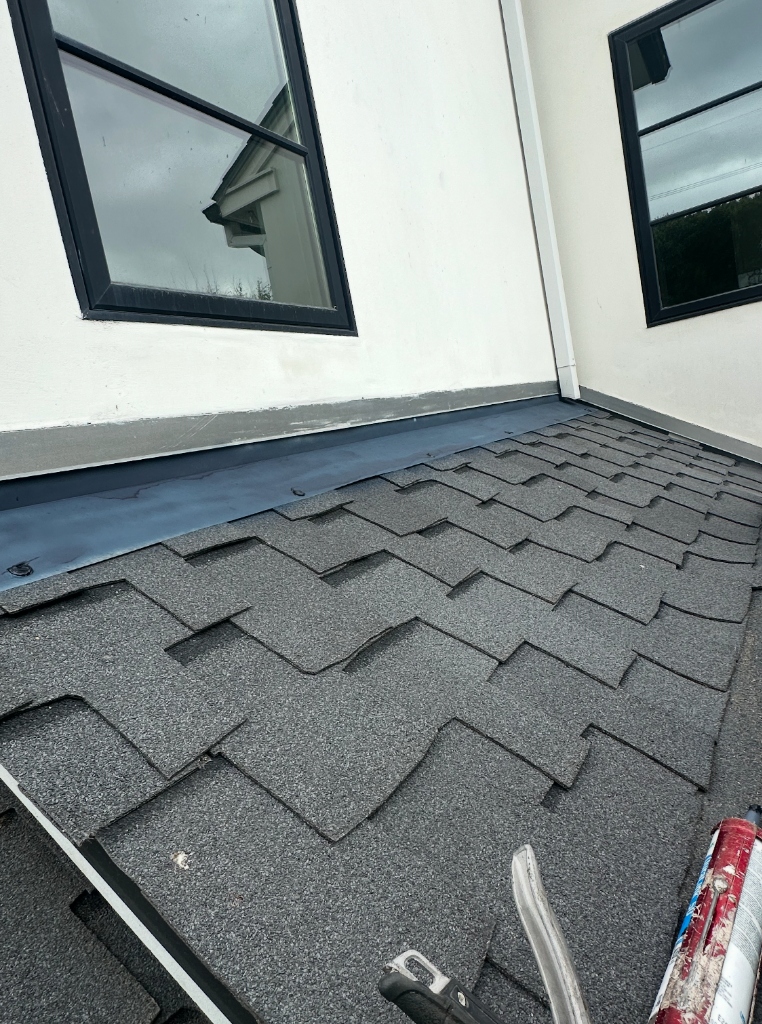
Where a pitched roof terminates against a second-story stucco wall, flashing must be integrated beneath the building paper and counterflashed. In Southern California, thermal movement causes stucco to crack along the roofline. If you notice bubbling paint, efflorescence (white mineral crust), or dark streaks on the wall beneath the roofline, step flashing has failed.

Warning Sign 2: Rusted or Debris-Clogged Valley Channels

Valleys funnel the highest volume of storm runoff on any roof. In the Antelope Valley, blowing dust and tree leaves collect in valleys, forming natural dams. Water backs up laterally behind the valley flange, penetrating nail penetrations and rusting galvanized metal from the backside.

Warning Sign 3: Rotted Fascia Boards and Peeling Eaves

If your roof lacks a drip edge flashing along the lower eave, surface tension causes rainwater to curl backward under the bottom shingle edge, soaking the sub-fascia board and rafter tails. Over 5 to 10 years, this causes extensive dry rot, termite attraction, and loose gutter hangers.

Professional Safety Precautions
  • Sheet metal flashing edges are razor sharp; never handle metal flashing without cut-resistant leather gloves.
  • Do not lean ladders directly against aluminum drip edge or copper gutters without ladder stand-off stabilizers.

Repair vs. Replace Decision Matrix

When to Repair
  • •Flashing metal is structurally intact and failure is limited to dried-out counterflashing sealant or a localized rusted seam.
  • •Adjacent roofing materials are in good condition and can be safely unlapped and reinstalled.
  • •Wood decking behind the flashing shows zero structural rot.
When to Replace
  • •Galvanized metal has rusted completely through, creating open holes in valleys or step corners.
  • •Stucco or brick walls require reglet re-cutting and complete flashing re-fabrication.
  • •The roof is undergoing full replacement; building code mandates new flashing installation with new roofing.

Frequently Asked Questions

Can you reuse old roof flashing when installing a new roof?

California building code and manufacturer warranty guidelines require replacing flashing whenever a roof is torn off and replaced. Reusing old, fatigued flashing voids manufacturer warranties and invites premature leaks.

What gauge metal does APR Roofing use for roof flashing?

We use commercial-grade 26-gauge galvanized steel or pre-painted aluminum, engineered to resist desert temperature swings without warping or buckling.

Direct California C-39 Dispatch

Need Professional Assistance With Your Roof?

Our 100% in-house trained crews provide certified leak diagnostics, storm inspections, and permanent repairs across Lancaster, Palmdale, Santa Clarita, and Gardena.

Direct Engineering Answer: Roof Flashing Leak Warning Signs

APR Roofing Solutions (operated by Canaj Inc., California C-39 Roofing Contractor License CSLB #947534) executes code-compliant residential and commercial roofing across Lancaster, Palmdale, Quartz Hill, Santa Clarita, Monrovia, and Gardena using 100% in-house W-2 crews, ASTM Class F 130 MPH 6-nail wind fastening, dual-layer 240°F SBS tile underlayment, and GAF Master Commercial robotic TPO welding. Call (661) 406-0863 for a 21-point thermal drone inspection.

High Desert Climate Zone 14 Wind & Thermal Protocol

Antelope Valley roofs in Lancaster (93534, 93535, 93536), Palmdale (93550, 93551, 93552), and Quartz Hill face afternoon katabatic wind gusts exceeding 65 to 85 MPH alongside summer deck temperatures reaching 165°F. Standard 4-nail builder-grade shingles suffer rapid sealant fatigue, nail pull-through, and blow-offs within 7 to 10 years. APR Roofing Solutions eliminates wind uplift by enforcing a strict 6-nail fastening schedule into solid 1/2-inch CDX or OSB structural sheathing, paired with high-viscosity SBS-modified asphalt starter strips at all eaves and rakes, breathable synthetic polyolefin underlayment, and California Title 24 Cool Roof Rating Council (CRRC) reflective granules.

Spanish Tile Lift & Reset vs. Full Tear-Off

Concrete S-tile and two-piece clay Mission tile roofs in West Palmdale, Rancho Vista, Ana Verde, Santa Clarita, and Monrovia carry a 50-to-75-year structural shell lifespan, but the builder-installed single-ply 30-pound organic felt beneath them desiccates and cracks after 18 to 22 years. Our specialized Tile Lift & Reset procedure systematically stacks and preserves up to 95% of your existing tiles, replaces rotted wood fascia and sheathing, installs dual-layer 40-mil high-temperature (240°F) self-adhering SBS elastomeric membrane, upgrades valleys to 26-gauge Kynar-coated metal or copper W-valleys with weep baffles, and re-fastens tiles with corrosion-resistant stainless or hot-dipped galvanized screws—saving homeowners 35% to 45% compared to full tile replacement.

GAF Master Commercial TPO & Industrial Flat Roofs

For retail plazas, medical buildings, warehouses, and HOA multi-family complexes across Palmdale, Santa Clarita, Gardena, Torrance, and Carson, ponding water and HVAC curb leaks are the leading causes of interior drywall and inventory damage. As a certified GAF Master Commercial Roofing Contractor, our in-house commercial division installs 60-mil and 80-mil single-ply TPO membranes over tapered polyiso rigid insulation boards (R-20 to R-30). Every lap seam is fused using automated robotic Leister hot-air welders at 1,000°F to create a monolithic, root-and-chemical-resistant bond that reflects up to 87% of solar UV radiation and qualifies for 20-to-30-year No-Dollar-Limit (NDL) manufacturer warranties.

2026 APR Roofing System Engineering, Wind Rating & Lifespan Matrix (CSLB #947534)

Roofing System Architecture Underlayment & Fastening Spec ASTM Wind / Fire Rating Expected Lifespan 2026 Installed Range
High-Wind Architectural Cool Shingles Synthetic Deck Armor + 6-Nail High-Wind Schedule + Ice & Water Eaves ASTM D3161 Class F (130 MPH) / Class A Fire / Title 24 CRRC 30–50 Years $5.25 – $7.85 / sq. ft.
Spanish Clay / Concrete Tile Lift & Reset Dual-Layer 40-mil SBS Self-Adhering 240°F Membrane + 26-Ga Ribbed Valleys 110–130 MPH Hurricane Clip / Class A Fire 30–40 Years (Underlayment) $6.50 – $9.75 / sq. ft.
New Spanish Mission / Concrete Tile Roof Elevated Redwood/E-Batten System + Dual SBS Membrane + Bird-Stop Eave Closure 125+ MPH / Class A Fire / High Thermal Mass 50–75 Years $11.50 – $18.00 / sq. ft.
Commercial 60-Mil / 80-Mil Single-Ply TPO Tapered Polyiso Insulation + Mechanically Attached / Adhered + 1,000°F Robotic Welds FM Approved High-Wind Uplift / Title 24 Cool Roof (0.83 SRI) 25–30 Years $7.50 – $12.50 / sq. ft.
Call APRText Photo