
CA Lic #947534 (C-39)ActiveGAF Master Commercial • BBB Accredited100% In-House Crews
24/7 High-Desert & SoCal Dispatch: (661) 498-7663
APR Roofing Solutions Logo
APR ROOFINGSOLUTIONS • CSLB #947534
HomeRoofing Knowledge BaseCommercial TPO Roofing in Southern California: Single-Ply Authority Guide
Commercial Roofing 9 min read Updated 2026-10-29

Commercial TPO Roofing Guide: 60-Mil Single-Ply Systems & Title 24 Compliance

APR
Andre• CSLB #947534 C-39
Founder & Lead Roof Specialist, CSLB #947534
Commercial TPO Roofing in Southern California: Single-Ply Authority Guide
Direct Technical Answer

Commercial TPO (Thermoplastic Polyolefin) is the leading single-ply flat and low-slope roofing membrane in Southern California. Composed of ethylene propylene rubber polymerized with polypropylene, TPO features heat-welded seams that are 3 to 4 times stronger than glued rubber seams. TPO reflects up to 86% of solar radiation, meeting strict California Title 24 cool roof standards while providing 20 to 25+ years of watertight protection.

Key Technical Takeaways

  • Hot-air welded seams form a permanent monolithic molecular bond, eliminating failure-prone adhesives.
  • 60-mil TPO membrane is the commercial industry standard, providing superior puncture and UV defense over 45-mil.
  • White TPO drastically cuts building HVAC energy consumption by reflecting solar heat.
  • Title 24 Part 6 mandates minimum Solar Reflectance Index (SRI) values for low-slope commercial roofs in California.

Why TPO Dominates Southern California Commercial Roofing

Historically, commercial flat roofs relied on multi-ply Built-Up Roofing (BUR asphalt and gravel) or torch-down modified bitumen. While durable, asphalt roofs absorb massive amounts of desert solar heat, reaching 160°F+ and transferring thermal load directly into warehouse or office HVAC systems. TPO revolutionized commercial roofing by delivering a lightweight, clean, highly reflective membrane that reduces cooling energy expenses by up to 25-30%.

Membrane Thickness: 45-Mil vs. 60-Mil vs. 80-Mil

Choosing the correct membrane thickness is the most important decision for facility managers:

45-Mil TPO: Budget Option (12-15 Year Lifespan)

Thinner membrane with less weathering cap over the reinforcing scrim; susceptible to rooftop traffic and hail punctures.

60-Mil TPO: Industry Gold Standard (20-25 Year Lifespan)

Contains 33% more weathering thickness above the scrim; exceptional puncture resistance and longevity. APR Roofing standard for commercial installations.

80-Mil TPO: Maximum Durability (25-30+ Year Lifespan)

Heavy-duty commercial grade designed for roofs with heavy foot traffic, solar arrays, or extensive mechanical equipment.

The Power of Hot-Air Welded Seams

Unlike EPDM rubber roofs that rely on chemical seam tapes and glues (which dissolve over time under standing ponding water), TPO seams are fused using robotic hot-air welders operating at approximately 900°F to 1,000°F. The two membrane sheets melt together at the molecular level, creating a single continuous watertight sheet. The weld itself is stronger than the parent membrane.

Title 24 Cool Roof Compliance and Energy Savings

California Energy Code Title 24 Part 6 requires commercial low-slope roofs to achieve a minimum 3-year aged solar reflectance of 0.63 and thermal emittance of 0.75 (or an SRI of at least 75). APR Roofing installs Energy Star and Cool Roof Rating Council (CRRC) certified membranes that exceed all Title 24 efficiency mandates.

Professional Safety Precautions
  • Commercial roofs contain open skylights and low parapets; all OSHA fall protection (guardrails, warning lines, and personal arrest harnesses) must be active during installation.
  • Hot-air welding equipment operates at extreme temperatures; keep fire extinguishers on site during all commercial work.

Repair vs. Replace Decision Matrix

When to Repair
  • •The TPO membrane is under 15 years old and damage is isolated to a puncture from dropped HVAC tools or an unsealed pipe boot.
  • •Insulation beneath the breach is completely dry (confirmed via thermal imaging or core sampling).
  • •Seams across the general field remain tightly bonded and intact.
When to Replace
  • •The existing membrane shows widespread micro-cracking, crazing, or exposed reinforcing scrim.
  • •Extensive water intrusion has saturated the polyisocyanurate insulation board beneath the membrane.
  • •The roof has exceeded 20-25 years and multiple seam failures are occurring.

Frequently Asked Questions

How much does commercial TPO roofing cost in Southern California?

Commercial TPO re-roofing typically ranges from $5.50 to $9.50 per square foot depending on membrane thickness (60-mil standard), insulation R-value requirements, tear-off scope, and roof penetrations.

Can TPO be installed over an existing flat roof?

Under California building code (CBC 1511), a maximum of two roof layers are permitted. If your building has only one existing roof and the decking and insulation are dry, an engineered cover board and TPO overlay can save substantial tear-off costs.

Direct California C-39 Dispatch

Need Professional Assistance With Your Roof?

Our 100% in-house trained crews provide certified leak diagnostics, storm inspections, and permanent repairs across Lancaster, Palmdale, Santa Clarita, and Gardena.

Direct Engineering Answer: Commercial TPO Roofing Guide

APR Roofing Solutions (operated by Canaj Inc., California C-39 Roofing Contractor License CSLB #947534) executes code-compliant residential and commercial roofing across Lancaster, Palmdale, Quartz Hill, Santa Clarita, Monrovia, and Gardena using 100% in-house W-2 crews, ASTM Class F 130 MPH 6-nail wind fastening, dual-layer 240°F SBS tile underlayment, and GAF Master Commercial robotic TPO welding. Call (661) 406-0863 for a 21-point thermal drone inspection.

High Desert Climate Zone 14 Wind & Thermal Protocol

Antelope Valley roofs in Lancaster (93534, 93535, 93536), Palmdale (93550, 93551, 93552), and Quartz Hill face afternoon katabatic wind gusts exceeding 65 to 85 MPH alongside summer deck temperatures reaching 165°F. Standard 4-nail builder-grade shingles suffer rapid sealant fatigue, nail pull-through, and blow-offs within 7 to 10 years. APR Roofing Solutions eliminates wind uplift by enforcing a strict 6-nail fastening schedule into solid 1/2-inch CDX or OSB structural sheathing, paired with high-viscosity SBS-modified asphalt starter strips at all eaves and rakes, breathable synthetic polyolefin underlayment, and California Title 24 Cool Roof Rating Council (CRRC) reflective granules.

Spanish Tile Lift & Reset vs. Full Tear-Off

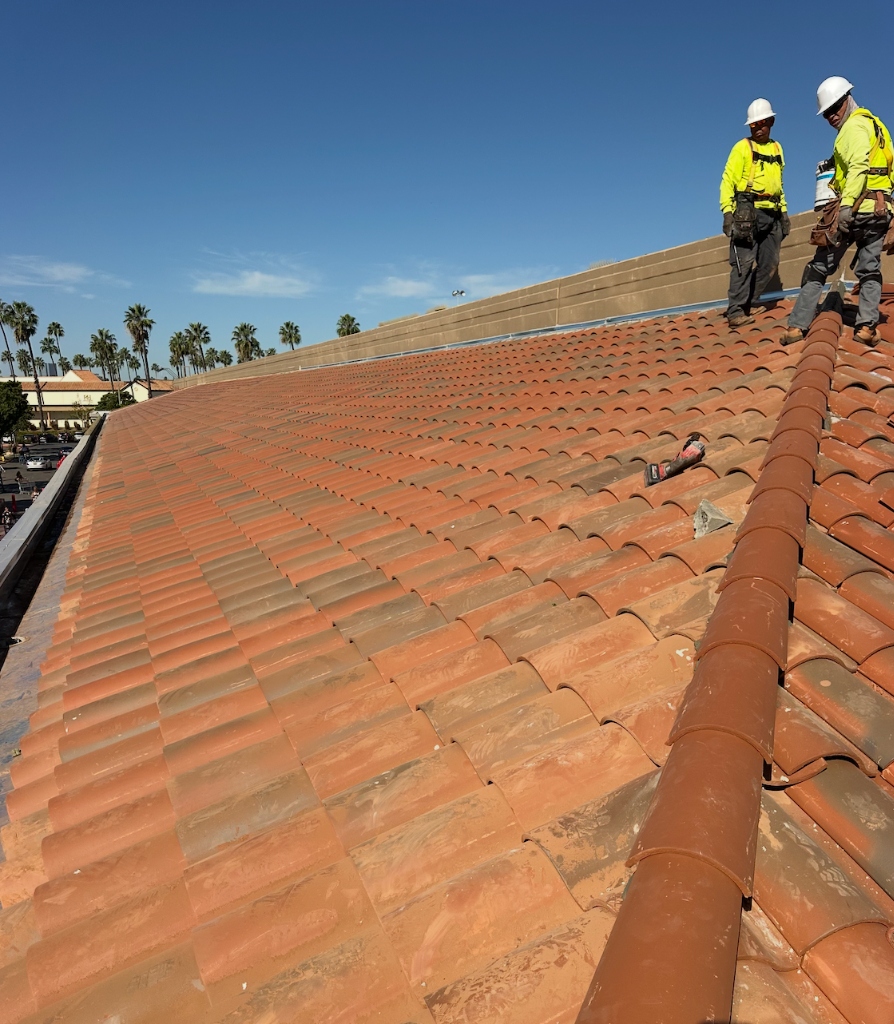
Concrete S-tile and two-piece clay Mission tile roofs in West Palmdale, Rancho Vista, Ana Verde, Santa Clarita, and Monrovia carry a 50-to-75-year structural shell lifespan, but the builder-installed single-ply 30-pound organic felt beneath them desiccates and cracks after 18 to 22 years. Our specialized Tile Lift & Reset procedure systematically stacks and preserves up to 95% of your existing tiles, replaces rotted wood fascia and sheathing, installs dual-layer 40-mil high-temperature (240°F) self-adhering SBS elastomeric membrane, upgrades valleys to 26-gauge Kynar-coated metal or copper W-valleys with weep baffles, and re-fastens tiles with corrosion-resistant stainless or hot-dipped galvanized screws—saving homeowners 35% to 45% compared to full tile replacement.

GAF Master Commercial TPO & Industrial Flat Roofs

For retail plazas, medical buildings, warehouses, and HOA multi-family complexes across Palmdale, Santa Clarita, Gardena, Torrance, and Carson, ponding water and HVAC curb leaks are the leading causes of interior drywall and inventory damage. As a certified GAF Master Commercial Roofing Contractor, our in-house commercial division installs 60-mil and 80-mil single-ply TPO membranes over tapered polyiso rigid insulation boards (R-20 to R-30). Every lap seam is fused using automated robotic Leister hot-air welders at 1,000°F to create a monolithic, root-and-chemical-resistant bond that reflects up to 87% of solar UV radiation and qualifies for 20-to-30-year No-Dollar-Limit (NDL) manufacturer warranties.

2026 APR Roofing System Engineering, Wind Rating & Lifespan Matrix (CSLB #947534)

Roofing System Architecture Underlayment & Fastening Spec ASTM Wind / Fire Rating Expected Lifespan 2026 Installed Range
High-Wind Architectural Cool Shingles Synthetic Deck Armor + 6-Nail High-Wind Schedule + Ice & Water Eaves ASTM D3161 Class F (130 MPH) / Class A Fire / Title 24 CRRC 30–50 Years $5.25 – $7.85 / sq. ft.
Spanish Clay / Concrete Tile Lift & Reset Dual-Layer 40-mil SBS Self-Adhering 240°F Membrane + 26-Ga Ribbed Valleys 110–130 MPH Hurricane Clip / Class A Fire 30–40 Years (Underlayment) $6.50 – $9.75 / sq. ft.
New Spanish Mission / Concrete Tile Roof Elevated Redwood/E-Batten System + Dual SBS Membrane + Bird-Stop Eave Closure 125+ MPH / Class A Fire / High Thermal Mass 50–75 Years $11.50 – $18.00 / sq. ft.
Commercial 60-Mil / 80-Mil Single-Ply TPO Tapered Polyiso Insulation + Mechanically Attached / Adhered + 1,000°F Robotic Welds FM Approved High-Wind Uplift / Title 24 Cool Roof (0.83 SRI) 25–30 Years $7.50 – $12.50 / sq. ft.
Call APRText Photo